


Thank you for visiting my blog. Much of this blog is dedicated to my passion for photographing the ever-changing palette at The Chicago Botanic Garden. I am fortunate to live within a few miles of this magnificent garden and I spend several days a week walking, observing and photographing the beauty this 385-acre slice of heaven offers. For me the beauty is in the details - the colors, the patterns, the tiny things that might otherwise be missed. Photography in general, but particularly nature and macro photography, teaches you to slow down and look at the world up-close, to observe the mysteries and wonders Mother Nature provides us.
"The contemplation of beauty causes the soul to grow wings." ~ Plato
Ranunculus in Bloom
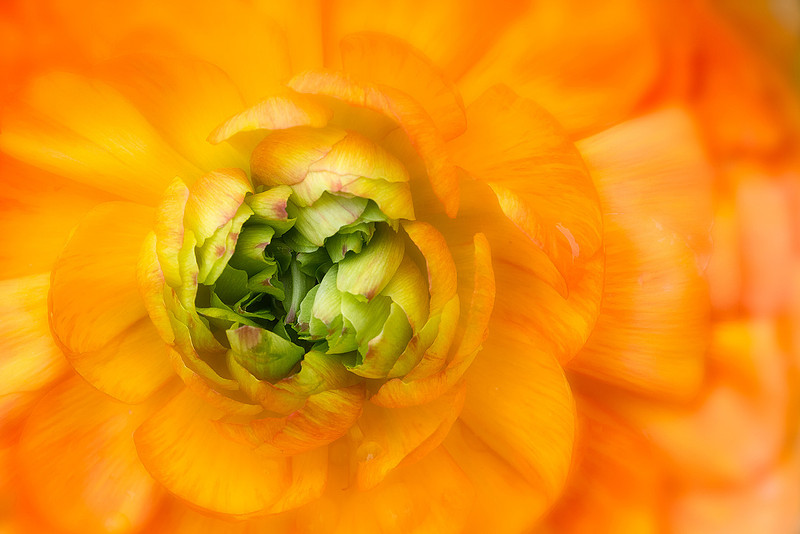
One of my many favorite flowers to photograph in spring is ranunculus, more commonly known as Persian buttercup. They are a happy diversion after the crocus and other early spring bloomers have faded and I am waiting for the tulips to bloom. The Chicago Botanic Garden usually puts ranunculus in the garden beds in mid-April, when frost and snow are no longer a worry. This spring there are two beds of ranunculus in the Heritage Garden, one is all yellow, the other with a mix of colors. The most spectacular colors and varieties and the easiest to photograph, however, are in the Enabling Garden's raised beds. There is also a bed of yellow ranunculus surrounding the Merrill Magnolia in the Bulb Garden.
I love the variations of color from one flower to the next and also within the same flower. The first photograph illustrates the beautiful layering of color within a single flower. It's fun to capture the patterns and swirls of the petals sharply focused and up-close or to open up the aperture and focus on one petal of the beautiful layers of the flower from the side. I love the way the flower unfolds in the center; it reminds me of the aperture blades of a lens.


 Each ranunculus is different and, as with any flower, I am constantly on the lookout for interesting patterns in the petals or something that sets a particular flower apart from others. I loved the swirl of this particular pale yellow ranunculus and the way the soft light falling on the petals accentuated that swirling pattern.
 And always a reminder to work your subject and shoot flowers from a variety of angles. Ranunculus, like many flowers, are just as interesting and beautiful from behind.
 The tulips are just beginning to open with our warm, sunny weather the past few days. I will be watching them closely and writing a blog post in the coming week with some tips for photographing tulips. I'm excited to be joining a photowalk to photograph the tulips in Holland, Michigan in a couple weekends so I hope to get some great shots there as well as at the Chicago Botanic Garden!
The Crocuses of Evening Island
I always wait with anticipation for the blooming of the crocuses on the grassy hillside on Evening Island at the Chicago Botanic Garden. The hillside is covered in purple, yellow and white crocuses, a sight to behold. This spring, with many rainy and chilly days, the crocuses were slow to open. They are fleeting, only staying fresh a few days once the sun and temperatures allow them to fully open. If it's overcast or chilly they will close back up, so timing is everything. They are unfortunately often trampled by children and adults who walk through the grass without watching their step, or those laying down in them to capture a selfie amidst the flowers. I have often seen parents allow their children to pick them, a concept that is hard to fathom in a public garden, but unfortunately happens. Yesterday they were in their glory, fully open in the sunshine but they won't last much longer.
Full sun can present a challenge when capturing the beauty of crocuses. If the sun is too strong, I use a diffuser to soften the light. Crocuses can be beautiful shot from the ground, allowing backlighting to illuminate the petals, but this kind of light will not work when trying to capture the inner structure and patterns of the crocus, when more diffuse light is needed.
Unless I am shooting the inner structure of the crocus I tend to prefer to photograph crocuses at lower apertures and create a soft portrait of the flowers. Lower apertures help to blur the brown grass the crocuses grow in.
Backlit crocuses shot with the Lensbaby Velvet 56 at f2.8.
 This patch of 'Remembrance' dutch crocuses was shot in the late afternoon light. The light illuminates the petals, showing their structure, but does not overwhelm them.
 A diffuser was used here to soften the strong light for this macro shot of the inner crocus. Although I often shoot hand held, a tripod (placed carefully so as not to disturb any flowers) is helpful when needing to hold a diffuser or shooting at higher apertures. My tripod has a tilting center column allowing it to go all the way to the ground.

 Here again, the soft late afternoon light provides beautiful light for capturing these lovely early spring blooms.

 In past years I have photographed the crocuses after a rain. The raindrops add textural interest to any flower. This year rain has accompanied chilly temperatures so the the crocus have been tightly closed after the rain.
 Another helpful hint is to carry a plastic garbage bag in your camera bag. The grass is almost always damp and the migrating geese frequent the hillside to nibble on the grass leaving plentiful presents behind. Because shooting crocuses means being down low to the ground, a bag to sit on is always a must. There is plenty of grassy space around the crocuses to place both a tripod and a bag without damaging any flowers.

The Emergence of Spring
Spring is emerging at the Chicago Botanic Garden and I'm there watching it unfold day by day. This is my favorite time of year to photograph. Watching and capturing the emergence of new life each spring is exhilarating to me. The snowdrops started appearing well over a month ago and, in fact, they are now beginning to fade. They are the first harbinger of spring and such a sweet, welcome sight after a long Chicago winter. They are hardy and can withstand snow and cold, popping up as early as January some years. The image below was photographed in the Waterfall Garden. These snowdrops bloom along the steps going to the upper falls, making them easy to get close to if you sit on the steps. Snowdrops are the perfect subject for the Lensbaby Velvet 56 lens. I almost always photograph them with a very wide aperture. Snowdrops can be a bit tricky to photograph - finding that perfect balance of focus in the main flower and curving upper stem and a nice blurred background to eliminate distractions. I spend a good deal of time looking for clumps of flowers that have a pleasing main subject and a nice composition surrounding. Because I am photographing them early in the season, before the gardens have been cleared of leaves and stray sticks, I often have to do a little "housekeeping" around the flowers I am photographing, gently moving dead leaves and debris from the dirt around the flowers. It makes my post processing work much easier and is worth the little bit of time and effort. I am a purist when it comes to photographing in a public garden - no touching or altering the plant itself under any circumstances.
 These 'Cream Beauty' Spring Crocuses in the lawn south of the Bulb Garden are usually the first crocuses to bloom each spring. I'm still waiting and watching the crocuses on Evening Island, my favorite crocuses to photograph. They are up but they have been tightly closed with our dip in temperatures and lack of sun this week.
 Many irises are up around the Garden. The 'Harmony' Reticulata Iris are in abundance in the Sensory Garden Woods. The horticulturist told me yesterday they replant these each year because many don't come back - all 12,000 of them! I love the mix of the Whitespire Birches and the purple irises - simply a beautiful sight!
 Another favorite iris is the 'Katharine Hodgkin' Iris in the Landscape Garden. I love the patterning on the petals and soft colors.
 The very first early tulips are blooming in the Bulb Garden - 'Early Harvest' Tulip. They were wide open with the sunshine and warmer temps over the weekend but they closed with the cold yesterday. I actually find them more interesting to photograph when they are partially closed; their colors are more intense on the outer petals and the subdued light makes them glow.
 So much more to come as spring unfolds. Let's hope for some sunshine and warmer temps. Stay tuned for regular updates as I capture the blooms of spring.
Photographing the Orchids at the Orchid Show
I had intended to post more about the Orchid Show long before this. Time is flying and the show is at its halfway point this weekend. I hope you all have had a chance to visit to see both my exhibit and the stunning display of over 10,000 orchids. The show is truly spectacular this year! This weekend the temperatures promise to reach into the 50's. What a perfect weekend for a walk at the Chicago Botanic Garden and a visit to the Orchid Show!
 In case you missed my article on the Out of Chicago website, you can read it here. It gives an overview of the show and some tips for shooting orchids. Since the weeks leading up to the show I have been busy and completely focused on capturing the orchids. I've shot over 6,000 images! Do you think I might be a tiny bit passionate about capturing these exotic and beautiful flowers?! I have challenged myself to keep growing and learning new ways to photograph these complex flowers. I have a strong conviction to keep growing as a photographer; in my eyes there is no such thing as mastering a genre of photography. One can always discover new ways to grow and learn. A few short months ago, I presented my macro flower photography class at the Chicago Area Photography School. During that presentation I declared myself a natural light photographer and conveyed that I couldn't get the results I wanted using flash. Yes, I do still prefer shooting in natural light, especially when shooting flowers outdoors. However, shooting flowers indoors, particularly the complex orchid, presents many challenges. Light in the exhibit can be contrasty and bright in the greenhouses and very dim in the inner rooms of the exhibit. Tripods, although allowed on Wednesday afternoons, are cumbersome to use in the pathways of the crowded exhibit. Even when I am shooting before the exhibit opens in the early morning, I am sensitive to being in the way of the busy horticulturists watering and working on the exhibit. This year I decided to revisit the use of a macro ring light and upgraded my previous model to the Yongnuo YN-14EX-C Macro Ring Light. It got excellent reviews and for $103 (compared to $549 for the Canon model), I felt it was a worth a try. The quality is impressive and I am thrilled with the results I am getting. The ring light allows me to shoot at higher apertures hand-held. It provides nice even, natural-looking light and helps to provide the necessary fill light to illuminate the inner structure of the orchid. The ring light has truly been a game-changer in how I can shoot the orchids. As with any flash, there is a bit of a learning curve to the use of a ring light, but I have found the Yongnuo easy and intuitive to use.
Here are some images I've captured with the ring light.


 But, of course, when I put on the Lensbaby Velvet to photograph orchids, I am relying on the beautiful natural light this lens is able to capture. This lens continues to amaze me!

Guest Post for Out of Chicago - The Orchid Show at the Chicago Botanic Garden
 The Orchid Show at the Chicago Botanic Garden opens this Saturday, February 13th. I've been behind the scenes shooting orchids for a few weeks and I couldn't be more excited for the show. My exhibit is hung and ready to welcome you as you enter the show. I wrote a guest post for Out of Chicago with details about the show and some tips for photographing orchids in the exhibit.
Garfield Park Conservatory
Winter in Chicago feels like it goes on forever and for those of us who are passionate about photographing flowers and plant life, it can be challenging to find enough subject matter to shoot. Chicago is blessed with two great conservatories - Garfield Park Conservatory and Lincoln Park Conservatory, along with the much-loved greenhouses at the Chicago Botanic Garden. These locations keep me happy and shooting the subjects I love throughout the long winter months. Last week I visited the Garfield Park Conservatory with my friend Lara Joy. Located at 300 N. Central Parkway in the city, Garfield is run by the Chicago Park District and it's free to the public. The conservatory is comprised of two acres of public greenhouse space as well as propagating houses and outdoor gardens. We spent a lot time photographing in the Show House (pictured below), which is the site of beautiful flower shows each year. The holiday amaryllis were still on display, along with many other flowering plants. Garfield does not allow the use of tripods, so on this gloomy, rainy day it was challenging to get enough light to hand-hold. I embraced the situation and shot softer focus images and enjoyed playing with my Lensbaby lenses, as well.


 Thoroughly exploring Garfield's many rooms requires more than a day. I decided to narrow my focus and chose to spend a good deal of time in the Desert House. Garfield has a varied and large collection of cacti and succulents in this large greenhouse. I enjoyed meeting and talking to Ray, a horticulturist in the Desert House, and he gave me a little tour of all his favorites in the Desert House. I am always awed by the passion of all the horticulturists I meet, their vast knowledge and their dedication to the plants they nurture. For me, part of the fun of photographing in these public spaces is meeting the people who care for them. They help me appreciate the uniqueness and beauty of the plants I photograph. Ray was so friendly and he introduced us to another horticulturist, Kathy, who gave us a behind-the-scenes tour of the propagating greenhouses. What a fun day it was. I can't wait to go back and more fully explore the rooms at Garfield. It's a great place to spend a cold winter day. A true Chicago treasure.


Out of Chicago Summer Photography Conference

The registration is finally open for the Out of Chicago Summer Conference, June 24-26, 2016! This is a photography conference not to be missed! Great instructors, workshops, photowalks, panel discussions and one-on-one sessions covering many genres of photography. If you register before January 14 you will receive $250 off the $499 price. This is a great price for a weekend packed with learning, networking and social events. Check out the amazing line-up of presenters and register here.
I am proud to be a part of the Out of Chicago team that organizes this conference and many other events. This year I am excited to be presenting two sections of 'Macro Flower Photography: The Art of Seeing and Capturing the Beauty of Flowers,' as well as leading a photo walk to Lurie Gardens with fellow macro photographer, Mike Moats. Check out my presenter page here.
Don't wait to register for this amazing conference. It will sell out quickly!
Lensbaby Velvet 56mm Lens
Last spring as the tulips were emerging the Lensbaby Velvet 56mm lens was released. I hopped right on board and ordered it. I was mesmerized by the images I saw being produced with this newest lens in the line-up of the Lensbaby lenses. Having owned the original Lensbaby Composer and macro converters, I was familiar with the unique qualities of these lenses, but I had no idea how completely smitten I would become with this lens as I began to experiment with it. As I look back over the past year photographically, the images I produced with this lens are some of my favorite of the year and they mark a definite move to capturing my subjects in a softer way. The Velvet is a 56mm f1.6 portrait and macro lens. As with all Lensbaby lenses, it is manual focus and manual aperture. Because the lens will focus as close as 5 inches, it is perfect for macro flower photography. The wide open apertures create dreamy images with a beautiful velvety and ethereal feel. Shooting at lower apertures means you can easily hand-hold this lens, but hand-holding with manual focus can be a bit tricky. Another thing I love about the Velvet is that the images require next to no post processing; often times I post them as they are straight out of the camera. Eager to continue to develop my softer focus work, Santa has promised me a Lensbaby kit with the Composer Pro and many of the optics I am eager to experiment with. Now, if only spring would come quickly and I can be back outdoors shooting flowers as I love doing the most. For now, I'll have to make do with indoor subjects and the Chicago Botanic Garden's Orchid Show is right around the corner. It will be fun to experiment with shooting orchids with the Velvet and my newer additions. Here are some of my favorite images shot with the Velvet through this year.
Sweet Bay Magnolia
 Clematis
 Grape Hyacinth
 'Julia' Coneflower
 'Much Niceness' Tulip

 Soft Curves of the Tulip
 Dahlia
 Fern Unfolding
 'Red Velvet' Echeveria

What's in a Name?
What's in a name? Well, the 'Annie Girl' Garden Chrysanthemum would smell as sweet and be as beautiful at any name, but the name certainly clinched it for me! Annie has always been my family nickname. These beauties in the Sensory Garden at the Chicago Botanic Garden have to be my favorite fall flower this year. Soft pink with that sassy burst of gold and they smell heavenly. Believe me, I know. I sat on the bed ledge photographing them for over an hour yesterday. As you will see in the last photograph I experimented with a fun technique of covering my lens with tulle to give a very soft focus effect.


 Don't miss the mum displays all over the Garden. They are really spectacular this year. Have you seen the display in the Crescent Garden? They go from deep red to gold in color and I love the addition of the Japanese maples along the path to the lake. Our colors are just starting to pop and the air is crisp and cool. Happy fall!

Last of the Butterflies
I enjoyed photographing in the Butterflies and Blooms exhibit at Chicago Botanic Garden every week during the summer. The summer flew by and Labor Day weekend saw the closing of the exhibit for the summer. The new location of the exhibit proved to be a wonderful change with beautiful views of both McDonald Woods to the north and the Japanese Garden to the south. I'm posting my favorite images for the summer. Some of the images were in a blog post earlier in the summer but they remain my favorites for the summer.
Orchard Swallowtail
 Buckeye
 Green Jay
 Mocker Swallowtail
 Paper Kites

 Postman
 White Peacock
 Blue Clipper
 Tiger Longwing
Lotus in Bloom
All the attention at the Chicago Botanic Garden has been centered around the Titan Arum or Corpse Flower, fondly called "Spike," that is about to bloom. You can read about it on the CBG website and even follow a 24/7 webcam so you know when the flower is blooming. Like expectant parents we wait, but it should happen any day, any hour now. It has brought many crowds to the Garden to watch the flower as it grows and progresses toward blooming. Meanwhile there are many things that continue to bloom at the Garden. In my frequent visits to check Spike, I continue to enjoy the beautiful water lilies in bloom in the Heritage Garden. This week I was lucky to catch a lotus in bloom. This 'Perry's Giant Sunburst' lotus has bloomed several times already but, unless you are there the day it blooms, you will miss it. They are spectacularly beautiful but are usually at their peak for photographing for one day. Not only was the flower in peak bloom but it was a nice overcast day, perfect for photographing aquatic blooms.


Victoria WaterLily
The Victoria waterlilies are in bloom in the Heritage Garden at the Chicago Botanic Garden. Many buds have already opened but there are plenty of buds to come. The Victoria waterlilies are a fascinating aquatic plant with beautiful flowers and large, thorny lily pads. They are native to the river basins of South America where they bloom from spring into the fall. They produce the second largest leaf of any plant in the world, reaching as large as 8 feet in diameter, depending on water and air temperature and water depth. The lily pads have ribs and large thorny undersides that help protect the pad but the surface of the pad is delicate and easily punctured, which is why the Garden asks guests not to throw coins on the lily pads. At CBG the Victorias typically bloom in late July through early fall. The day before the Victoria flowers it sends a large bud up to the surface of the water. The Victoria only blooms at night and each bloom lasts for 48 hours. On the first evening, the white flower (which is female) opens to lure its pollinator, a beetle, with its strong scent. The beetle feasts on the nectar of the flower and is trapped inside when the flower closes the morning of the second day. The flower opens again on the second night. This time it is pink in color and male. When it opens, the pollen-covered beetle is released to pollinate other flowers. The flower closes and sinks into the water to allow its seeds to germinate.


